Einheit: Theory (English) | Dierenartsen | Van Stal

  • Theory (English)

    • One of the most widely discussed topics in dog behaviour is the concept of “dominance”. In this article, we will take a closer look at what this term actually means and how it influences modern training techniques.

      The origin of dominance

      Our modern domestic dog originated through a long process of domestication from the wolf. Because of this, extensive research was conducted on wolves in an attempt to better understand dog behaviour. Between 1934 and 1942, researchers led by Rudolph Schenkel studied groups of wolves and their social relationships.

      It was assumed that a wild wolf pack was formed by individual wolves that needed each other in difficult times. For this reason, a group of unrelated captive wolves was observed with the aim of documenting their social relationships and analysing how these were formed. In this group, aggressive confrontations often occurred, ultimately resulting in the strongest individual prevailing. This individual was referred to as the “alpha wolf”.

      Because dogs are descended from wolves, this dominance theory was subsequently applied to domestic dogs.

      Many scientists adopted this conclusion, which helped maintain the dominance-based theory. Even today, dogs are still often viewed as animals on which dominance-based techniques should be used in order to prevent behavioural problems.

      wolf likt de snuit van een andere wolf

      In most cases, the dominance theory was used as an explanation, based on the idea that behavioural problems in dogs were caused by a drive to climb higher on the social ladder. Not obeying commands, sitting in higher places (for example, on the couch), walking through doors first, or eating before the owner were all seen as signs that the dog was trying to dominate the human. According to this theory, restoring a well-behaved household dog required breaking this behaviour through punishment and subduing the dog (Kovary, 1999).

      Wolf biologist Dr. L. David Mech reached similar conclusions in the 1970s and 1980s. Since even this leading biologist supported the idea at the time, the theory was widely accepted as fact.

      Criticism of dominance

      Let’s take a closer look at the original research. It was conducted on a group of unrelated wolves kept in captivity. Later, more research was done on wild wolf packs. This showed that wolves actually live in family groups. A father and mother lead the pack, and offspring leave the group once they are mature enough.

      During Schenkel’s and Mech’s early studies, the wolves were kept in a confined space with limited food. This naturally led to conflicts, which were not related to social rank, but rather to competition over food. Years later, the same wolf biologist, Dr. L. David Mech, concluded that the parent animals were not focused on dominating others, but instead on protecting and caring for the group. Conflicts were rarely resolved through aggression (Mech, 2008). Mech therefore revised his earlier findings and concluded that the term “alpha wolf” was no longer appropriate.

      Increasing research supported the view that this earlier image of wolves did not reflect their natural behaviour in the wild. Several researchers concluded that the initial studies were not representative.

      Since more and more studies show that there is no strict hierarchy in wolf packs (let alone one maintained through aggressive behaviour), the argument that dogs display such behaviour is also undermined (Van Kerkhove, 2004).

      And what about feral (street) dogs?

      Feral dogs live much closer to domestic dogs than wolves do. However, research shows that even among street dogs there are few conflicts that indicate a strict hierarchical structure. Their social organisation differs from that of wolves, as feral dogs do not (or no longer) live in family units. Their behaviour is better explained by circumstances, learning experiences, and motivation. Most interactions are characterised by “calming signals”, which serve to reduce conflict. These behaviours are therefore not aimed at submission to a dominant dog, but at de-escalating situations.

      The term “dominance” is also often misused. Dominance is, in fact, a description of a relationship between two individuals, not a personality trait or behavioural characteristic. This relationship can change depending on context and time. A dog that may take possession of a bone in one situation may not do so in another.

      So does dominance exist at all? Yes, but it is not a goal in itself. It is simply a description of the current relationship between dogs and/or humans, which can change depending on moment and context.

      In short, multiple studies have shown that dogs do not seek a dominant position or controlling leadership, nor do they need it.
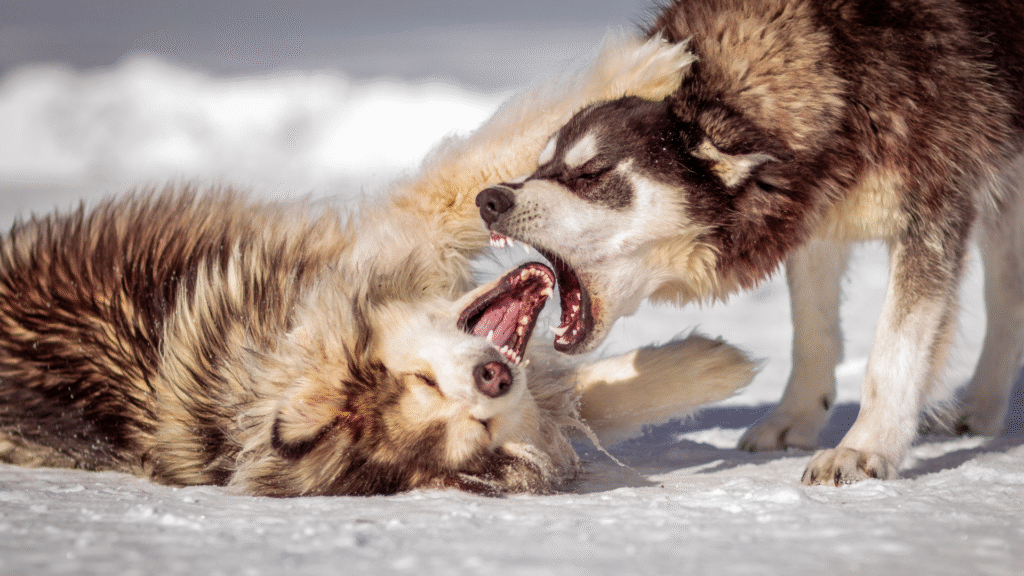
      hond speelt met andere hond, die op zijn rug ligt in de sneeuw

      Behaviour vs. training

      But what about behaviour we would rather not see? For example, growling when the dog is on the couch? Pulling on the leash? Reacting aggressively on leash? Or mounting people’s leg?

      A study by Bradshaw (2009) examined a group of 19 dogs living in one household. It found that, based on their interactions, no stable hierarchy could be established. However, conflicts did occur, which were sometimes resolved through calming signals or through aggression. This behaviour is better explained by the concept of “Resource Holding Potential”: the motivation to obtain or retain something of value to the dog.

      An example:

      If a dog is lying on the couch, this may be a highly rewarding and comfortable place. If it is strongly motivated to stay there, it may growl in order to keep the spot. However, if its motivation is lower, it may simply leave without protest.

      If a dog pulls on the leash, this is usually related to a strong motivation to get somewhere. The reason may be obvious (another dog) or less obvious (for example, wanting to move away from a frightening situation). But this has nothing to do with dominance or attempting to control the direction of movement.

      As discussed earlier, behaviour is primarily explained by the emotions a dog experiences (Panksepp, 2005). Dogs experience seven basic emotional systems: seeking/desire, rage, fear, lust, care, panic/grief, and play. These emotions, combined with learning experiences, shape the behaviour we observe.

      For example, a dog that growls at its food bowl. Body language often shows that this is rooted in fear—fear of losing its food. If it growls and you move away, the dog learns that growling successfully reduces its anxiety. If a neighbour approaches and the dog does not growl, it may be because the dog has never had a negative experience of them taking its food. There is therefore no learned threat response. This leads to two different reactions in what appears to be the same situation—once again often misinterpreted as dominance, while the real explanation lies in past experiences.

      Within dominance-based thinking, physical interventions are often used: an “alpha roll”, a shove to the side, or forcing the dog onto its back in order to “subdue” it. If a dog is reactive on leash, it may be physically restrained to “assert control”. At first glance, these methods may appear effective.

      Because of this, many “trainers” consider it a quick way to correct unwanted behaviour. However, the opposite is often true. Many dogs stop the unwanted behaviour out of fear of consequences, not because they have actually learned alternative behaviour. They may develop a state known as “learned helplessness”, which is considered a serious psychological condition. In addition, the dog may become more anxious, which can increase its motivation to defend resources such as food. This ultimately damages the relationship with the owner.

      Would we not prefer a dog that trusts us, respects us, feels supported, and shows affection? Then we must offer the same in return. Respect its behaviour, emotions, and needs, and support it where necessary.

      If we suppress growling, there is a real risk that the dog will skip the warning signal and go straight to biting. This makes behaviour less predictable and increases the risk of the dog ending up in a shelter.

      By focusing on the underlying emotion and motivation, alternative, non-physical methods can be used to teach the dog different behaviour. This may take more time, but it leads to a stronger bond between dog and owner, and more durable behavioural change.

    • My puppy puts everything in his mouth

      Puppies, just like babies, explore the world with their mouths. Stones, tissues, cigarette butts, sticks, leaves… everything gets tried out. And only then do you really notice how dirty the streets actually are! Many owners find this behaviour worrying or frustrating, and that’s completely understandable.

      Still, it’s part of your puppy’s development: he learns by exploring. The real question is: how do you best deal with this?

      Try seeing the world through your puppy’s eyes

      When should you not react?

      If your dog picks up something harmless, like a leaf, stick, or piece of paper, in most cases it’s better not to react immediately.

      The more stress or tension you show, the more interesting it can become for your puppy. Many dogs actually learn to swallow things faster just to prevent you from taking it away.

      So try to look ahead during walks and prevent your puppy from picking things up in the first place.

      If he does pick up something small anyway, stay calm and keep walking. Often, he will drop it a few metres later on his own.

      Make letting go (or not picking up) rewarding!

      You want your dog to lose interest in picking things up, or to happily give something back to you when he already has it. You can teach this using an exercise like “leave it”.

      Teaching “leave it”

      Start by pairing the cue “leave it” with something positive.

      Say “leave it” and immediately give a treat. Repeat this several times.

      Then say “leave it” at the moment your dog briefly looks away.

      If all goes well, he will look back at you expecting a reward. Reward that immediately.

      Next, practise with an object in your hand. Show it briefly, say “leave it”, and as soon as your dog shifts his attention back to you, reward him.

      Build this up step by step until you can place or drop something on the ground and your dog learns to leave it alone on your cue “leave it”.

      This way, your puppy learns to keep his attention on you instead of everything he encounters on walks.

      When should you intervene?

      If your dog has something dangerous in his mouth, such as a cigarette butt, wooden skewer, or plastic, then you should intervene.

      Stay as calm as possible, gently open his mouth, and remove it.

      Always give something tasty in return afterwards, so the experience ends positively instead of negatively.

      Good luck practising!

      With patience, calmness, and positive associations, your puppy will naturally learn what is and isn’t appropriate.

    • What your dog is really saying (and why it matters so much)

      In the video, you can see how your dog’s behaviour looks in practice. What is often less visible—but just as important—is what lies underneath.

      Behaviour is never just behaviour. It is always an expression of an emotion, and that emotion is what your dog is constantly trying to communicate with you.

      Dogs are communicating all day long—without words

      Where humans mainly communicate through language, dogs rely almost entirely on body language. In fact, most of their communication is non-verbal.

      This includes:

      • body posture
      • ear position
      • tail position and movement
      • muscle tension
      • gaze and eye contact

      By combining these signals, a dog shows how he is feeling.

      Important: one signal on its own means very little. It is always about the overall picture.

      From subtle to clear: the build-up of behaviour

      What you often see in the video is the “final behaviour”:

      • barking
      • growling
      • lunging
      • pulling

      But this behaviour rarely appears out of nowhere.

      There is usually a whole build-up of smaller signals first:

      • looking away
      • tension in the body
      • slower movement
      • freezing or becoming still

      Many of these signals are subtle and therefore missed. Yet they are crucial: they give you the opportunity to step in earlier and help your dog.

      What we experience as “sudden behaviour” is often the result of signals we did not notice.

      Emotion as the foundation of behaviour

      Every behavioural response comes from an emotion, such as:

      • insecurity
      • tension
      • frustration
      • excitement

      For example:

      • A dog that lunges → often tension or insecurity
      • A dog that shows hyper behaviour → often excitement or frustration

      If you only correct the behaviour, you do not change the emotion. And without changing the emotion, the behaviour usually returns.

      Why timing is everything

      In the video, you may see moments where the behaviour is already visible. But the real progress happens before that.

      The difference between:

      • reacting after behaviour
      • guiding before behaviour

      depends on:

      • recognising early signals
      • acting at the right moment

      The earlier you intervene, the easier it becomes for your dog to show different behaviour.

      Your influence as an owner

      Something often underestimated: your behaviour directly influences your dog.

      Think about:

      • leash tension
      • body posture
      • energy / emotional state
      • expectations

      Dogs mirror our behaviour. If you feel tension, your dog is very likely to pick up on it.

      So you are not only a guide—you are part of the situation.

      Small adjustments, big results

      You often do not need major changes to make a difference. Small adjustments can already have a huge impact, such as:

      • increasing distance from triggers
      • choosing better timing for rewards
      • creating moments of rest
      • providing clarity and structure

      This helps your dog think again, instead of only reacting.

      Learning to observe instead of correct

      The core of this lesson—and the video—is not just what you should do, but how you learn to observe.

      Because once you:

      • see signals earlier
      • understand emotions better
      • read context more accurately

      training stops being a set of tricks and becomes real communication.

      In conclusion

      Your dog is communicating all day long.
      The question is not whether he communicates, but whether we notice it.

      The better you learn to observe, the easier it becomes to guide your dog toward calmer, more stable behaviour.

    • The socialisation period of your puppy: the foundation for a stable dog

      When you bring a young puppy into your home, you enter a fascinating and critical developmental process. The phase in which your puppy transitions from the safe nest environment into the wider world—the so-called socialisation period—largely determines how he will function as an adult dog. Let’s highlight some key points: not just what you do, but how you do it, and which pitfalls to avoid.

      What is the socialisation period?

      The socialisation period is the phase in which a puppy learns what is “normal” in his environment: which people, animals, sounds, surfaces, and situations he will encounter throughout his life as a household dog.

      Because this phase takes place at a young age (roughly between 3 and 12 weeks, followed by a second phase up to around 6 months), it is both a window of great opportunity and of potential risk.

      Everything the puppy learns, experiences, and encounters during this time will be considered “normal” later in life.

      So: what you sow now, you will reap later.

      Phases within socialisation

      To make it more practical, the socialisation period can roughly be divided into two stages:

      Early socialisation phase (≈ 3–12 weeks):
      In this phase, the puppy is highly curious, open-minded, and sensitive to new impressions. He learns about people, other animals, sounds, surfaces, and all kinds of stimuli. This is the time to build a broad foundation.

      Second socialisation / fear phase (≈ 12 weeks to ~6 months):
      After the initial window, a phase often follows in which the puppy becomes less naturally open to novelty. He may suddenly react more fearfully to things he previously approached confidently. This phase requires repetition, reassurance, and good guidance, because unprocessed experiences can now have a lasting impact.

      Why is socialisation so important?

      A well-socialised puppy will later be better able to cope with unexpected situations, people, other dogs, sounds, and changes.

      A poorly socialised dog has a higher risk of problems such as fear, overstimulation, aggression, or withdrawn behaviour.

      In other words: the foundations for a stable, confident dog are laid during this period. It is not a “nice extra”, but one of the most important aspects of upbringing.

      What should your puppy experience—and more importantly, how?

      There are many checklists of things your puppy “should be exposed to”, but what matters more is how well you execute those experiences. Quality over quantity.

      If you rarely take the bus, there is no need to force that experience early on. If your dog has ridden in a car a few times and feels comfortable, you don’t need to immediately add trains and trams. If you walk regularly with a bicycle, that is a useful experience to include. If you want your dog to be comfortable around other animals, a visit to a petting zoo is enough—you do not need to visit every possible variation of animal parks and exhibitions.

      In general, socialisation already happens the moment you step outside (or even indoors). Think of vacuum cleaners, brushing, sounds, visitors, TV, being alone, and so on—all stimuli your puppy has to process in his “empty” developing brain.

      How should you approach this?

      A useful mindset is: “I don’t need anything from…”

      • I don’t need anything from a doorbell
      • I don’t need anything from a cyclist
      • I don’t need anything from a horse
      • I don’t need anything from people on the street
      • I don’t need anything from a runner
      • I don’t need anything from another dog
      • I don’t need anything from …

      Practical example (horse exposure)

      During our puppy classes, we use a horse as part of socialisation. The goal is that the puppy learns: “I don’t need anything from this horse.”

      During the exercise, the horse calmly moves around under guidance. The distance between the puppies and the horse is kept sufficiently large. The puppy may observe curiously, then choose to sniff or disengage. Perfect—that is the learning experience: “I don’t need anything from a horse.”

      If the puppy moves toward the horse in excitement or tension, the situation is too difficult and the distance is increased. At a greater distance, the puppy can return to calm behaviour—exactly what we want to see. What you see is what you get.

      Never force your puppy into interaction. Socialisation and feeling safe happen at the puppy’s own pace.

      Be careful with negative associations

      Many owners feel the urge to let the puppy “meet” the stimulus directly. This is often not a good idea if you do not have full control over the situation.

      If a puppy gets too close to a horse and the horse suddenly moves, lowers its head, or makes a loud sound, the puppy may get scared. This can create a negative association instead of a positive one.

      Such negative experiences can lead to fear-based reactions later in life, often becoming reactive behaviour during adolescence.

      If you are unsure about a situation, avoid it. If necessary, pick your puppy up and walk away. This does not reinforce fear.

      Also allow your puppy enough time to process experiences. A rest day is not only fine—it is essential.

      Common pitfalls and how to avoid them

      Pitfall Why it is a problem What to do
      Starting too late The optimal learning window is already partly closed Start immediately when the puppy arrives and continue into the second phase
      Overexposure / overstimulation Too many new impressions create stress and can link novelty to fear Read body language, pace exposure, and include rest days
      Negative first experiences Can lead to lasting fear responses Ensure controlled exposure, distance, and positive reinforcement
      No repetition in fear phase Early progress can break down without reinforcement Continue socialisation beyond 12 weeks
      Random exposure without meaning Stimuli without context are less effective Create meaningful experiences and positive associations
      Unsafe dog interactions Uncontrolled encounters can cause fear or disease risk Choose controlled, calm, well-socialised dogs instead of random dog parks

      In conclusion: what is the core message?

      The socialisation period of your puppy is not a luxury or optional part of training—it is the essential foundation for his future wellbeing, behaviour, and lifestyle.

      It is about conscious guidance, making good decisions, and recognising potential pitfalls.

      As an owner, your responsibility is to turn this phase into a positive journey of discovery rather than a stressful checklist of experiences to tick off.

      If you are unsure or do not trust a situation, avoid it. If needed, pick your puppy up and walk away. This does not reinforce fear.

      A well-guided socialisation period leads to a dog that can face the world with confidence, calmness, and stability.

    • Giving medication to your dog

      Giving medication to your dog might seem like something small, but for many dogs (and owners) it can be quite stressful. Pills, drops, or ointments are often introduced only when they are really needed—and that’s exactly when pressure is already high. Your dog may not be feeling well, you may feel stressed, and before you know it, giving medication becomes a struggle.

      By practising medication handling in advance, you teach your dog that this is not a threatening situation. We focus on predictability, trust, and cooperation, so that giving medication becomes as calm and safe as possible. Not by holding your dog down or forcing it, but by building positive associations step by step and carefully observing what your dog can handle.

      In this way, you prevent stress, escalation, and conflict—and instead help your dog exactly when he needs you the most.

    • Step-by-step guide: teaching your dog to wear a muzzle

      Introducing a muzzle at a young age can have many benefits for both dog and owner when the dog reaches adulthood. In this step-by-step guide, the muzzle is introduced in a dog-friendly way, using small, gradual steps so that the process remains positive for both dog and owner.

      Keep in mind that learning something new takes time. Patience is essential. Do not rush and pay close attention to your dog’s body language. Keep training sessions short (maximum 10 minutes), especially with young dogs. Also make sure the muzzle fits properly at all times.

      Step 1: Show the muzzle

      Show the muzzle to your dog. When your dog sniffs it, reward with a food treat. Repeat this a few times. Do not move the muzzle toward your dog; instead, allow your dog to make the choice to approach it. Then remove the muzzle again.

      Step 2: Touching the muzzle

      Show the muzzle again and see if your dog wants to touch it. Touching the muzzle is rewarded with a treat. You can also use your voice as reinforcement.

      Step 3: Putting the nose into the muzzle

      When your dog touches the muzzle, hold it in such a way that your dog can gently place his nose inside. Reward immediately, even if it is only a small step inside.

      Step 4: Only touching is no longer rewarded

      Simply touching the muzzle is no longer rewarded. The further your dog puts his nose into the muzzle, the bigger the reward becomes.

      Step 5: Holding the muzzle in front of the nose

      Hold the muzzle in front of your dog’s nose and invite him to put his nose inside. Gradually increase the distance, so that your dog may start coming toward you from a short distance to place his nose into the muzzle.

      Step 6: Keeping the nose in the muzzle

      Let your dog get used to keeping his nose inside the muzzle. Start with just a few seconds and slowly increase the duration. Reward by giving treats through the opening of the muzzle.

      Step 7: Fastening the straps

      When your dog stays calm with his nose in the muzzle, you can briefly fasten the straps. Reward immediately and then remove the muzzle again. You can also practise fastening the straps first without the dog.

      Step 8: Wearing the muzzle for longer periods

      If fastening goes well, gradually increase the duration of wearing the muzzle. Watch your dog’s body language closely. If your dog tries to remove the muzzle, take a step back. Reward calm behaviour.

      Step 9: Walking with the muzzle

      Take a short walk while your dog is wearing the muzzle. Start calmly and do not immediately go for a long walk. Build this up gradually, just like in the previous steps.

      Source

      Doggo.nl (2022). Fun muzzle training in 9 simple steps.
      https://www.doggo.nl/artikelen/hondentraining/muilkorftraining-in-9-simpele-stappen/

    • Upload a video of one of the previously completed exercises if you would like to receive feedback.
      Please note: this feature is only available when you are logged in with an account.

    • You’ve viewed all the sections (or skimmed through them), so you’ve reached the end of this mini-course.

    • By clicking the link below, you will be taken to our course offerings. Please feel free to email us if you would like more information.